What does "no cost" actually cover?
It covers the equipment and the work of keeping it running. That is a real thing and it is worth having. It is also narrower than the pitch sounds.
Under a placement deal the operator owns the machines, delivers them, installs them, repairs them, and comes back to collect. You supply the floor space, a wall outlet, and staff who know what is sitting in the corner. You buy nothing. If that model is new to you, we walked through the basics in what it takes to add a game machine to your bar.
The trade has a standard form for this, and it is public. RePlay Magazine, the monthly for the coin-op amusement business, publishes a Standard Location Agreement that operators hand out with small edits. Clause 4 puts routine service and maintenance on the operator and says the location "shall not be responsible for the ordinary maintenance and repair of the equipment". Clause 8 puts parts and supplies on the operator too.
Read clause 8 to the end, though. The same sentence puts every city, county, state and federal licence, permit or tax for the equipment on you. And it makes you solely responsible for damage from theft, vandalism or negligence. No cost is not the same as no line items.
So where is the catch?
There is no catch. There is a contract, and most owners sign it in about four minutes.
Here is the part that surprises people. The standard form does not contain a split. Clause 2 reads LOCATION blank percent, OPERATOR blank percent, and then a minimum dollar amount per week to the operator per game. The number is negotiated and typed in. Nobody publishes theirs, either. Across the operators ranking for this exact search, not one states its contracted split on its website.
So the percentage is not the question to lead with. The question is what the percentage is applied to. Every dollar the machine takes in? What is left after prizes? What is left after prizes and fees? Two deals with the same number on the page pay very differently depending on that sentence, and the standard form does not write it for you.
One more line in clause 2 catches owners out. Unless you agree otherwise in writing, no allowance is made for house play or machine promotion. If you were planning to comp a few plays to warm the corner up, get that agreed first.
How long is a standard placement agreement, really?
Five years, and then another five, unless you post a letter on time.
Clause 3 sets the term at sixty months. After that it renews itself automatically for a like period on the same terms, unless one side sends written notice by registered or certified mail at least one hundred eighty days before the term ends. One hundred eighty days is six months. Which means your decision is not due at month 60. It is due at month 54.
Miss that date by a week and the same agreement runs to month 120. Ten years of your floor, decided by a letter you forgot to mail in year five.
Two more clauses ride along with the term. Clause 2 owes the operator a minimum dollar amount every week per game, whatever the machine does. Clause 9 gives the operator the sole right to pick and rotate the type and number of machines on your floor. You are agreeing to a company, not to a specific piece of equipment.
What does exclusivity actually stop you doing?
It stops you putting anybody else's equipment in the building, including equipment that takes no coins.
Clause 1 grants the operator the exclusive right to place amusement equipment at your address, and makes you warrant that no competing agreement exists and that none will be signed while this one runs. Clause 5 goes further. You agree not to purchase, rent, install or permit to be installed similar equipment from anyone else, "including competing equipment not operated by coins".
That last phrase is doing a lot of work, and the form never defines "similar equipment". A card reader dartboard, a tablet on the wall, a jukebox that runs off an app: all of them are arguably inside the fence. Get the categories you intend to keep written into the paper by name. That is a two minute conversation before signing and a lawyer's bill afterwards.
What happens if you remodel, close, or sell the bar?
Under the standard form, all three are your problem.
Clause 3 says you stay responsible for the payments even if the premises close. It then lists the reasons it does not care about: fire, other damage, remodeling, suspension or revocation of licences, and loss of lease. Any such closure is deemed a breach. Clause 6 says that if you sell the business you have to get the buyer to accept and assume the agreement, and that if you move, the agreement moves with you.
Clause 7 is the one to read twice. On a breach, the operator can recover every payment it would otherwise have earned across the whole remaining term, all of it immediately due. The clause expressly says those damages are not reduced by anything the operator makes placing the machines somewhere else, and it adds attorney fees on top. Do the arithmetic on your own room. A kitchen fire in month 12 leaves forty eight months of the operator's average weekly take payable at once, while your doors are shut.
None of this makes the standard form dishonest. It is an operator's form, written by operators, and it protects the party that spent the money on the machines. It is simply not written to protect you, and nobody is going to tell you that across the bar.
What should you get in writing before you sign anything?
Six things. Every one of them is a sentence, not a renegotiation, and any operator worth signing with will put them in.
- The exact date your notice is due. Not "one hundred eighty days". A calendar date, written into the agreement, that you can put on the wall.
- What the split applies to. Gross into the machine, or net of prizes, or net of prizes and fees. One sentence, in the contract, in plain words.
- What "similar equipment" means. List what you keep. Your pool table, your jukebox, your dartboard, your quiz night tablet.
- A closure carve out. Fire, flood, a landlord who does not renew. Ask that a closure outside your control suspends the agreement instead of breaching it.
- A service response time. The standard form promises repairs "as rapidly as circumstances will permit", which is not a promise. Ask for hours, in writing.
- What the reporting looks like. Ask to see a real collection statement before you sign, not after. If the answer is vague, you have learned something.
If you want the wider version of this list, covering the company rather than the paperwork, it is in what to ask before signing with any entertainment vendor. And if you are still deciding between placement and buying a cabinet outright, we split those two questions apart in countertop games for bars.
Where does Foxfire fit?
Same model, and we would rather you asked us all six questions than skipped them.
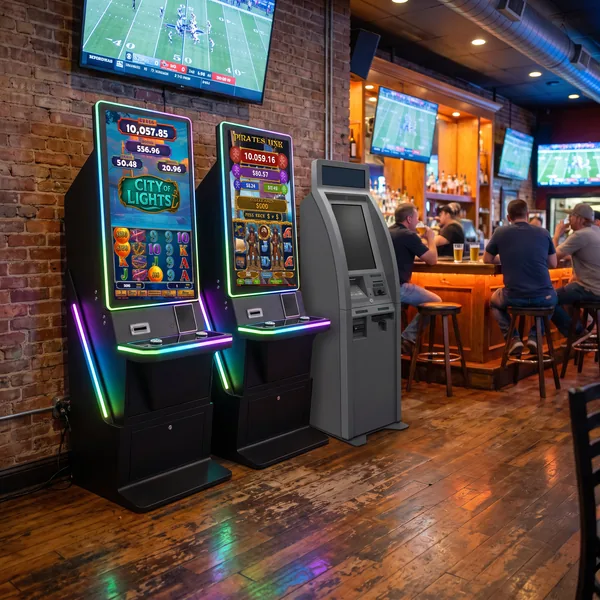
Foxfire provides the machines and the redemption kiosk, delivery and installation, service and maintenance, and collections and reporting. You provide the space and a standard 120V wall outlet. Setup is $0 and maintenance is $0. The footprint is small. One machine is about 2 ft by 2 ft. A full standard install is two machines plus the kiosk, about 6 ft by 2 ft, which is roughly 12 square feet of floor.
What is on the floor is a no-chance video game system. Players preview their outcome, choose to play, and collect their prize. It is certified legal in all 50 U.S. states by Eclipse Compliance Testing. That is an independent accredited lab used by state gaming authorities, and its verdict on the device reads: "This device is not a slot machine."
What it earns comes down to three things, and no marketing copy shortens the list: how many people come through your door, how often they play, and how many machines are on the floor. Ask any operator to walk you through that arithmetic on your own room, ours included. If you want the model rather than the contract, see how it works.