How much does one game machine actually make in a bar?
It depends entirely on your bar, and any flat number claiming otherwise is a guess wearing a suit. Search that exact question and you will land on pages quoting monthly ranges anywhere from fifty dollars to six hundred dollars a machine, sorted by game type, with no source behind a single figure. One widely shared vendor post breaks it down by category, classic arcade games, redemption games, prize cranes, and hands you a number for each, and never once says where the number came from.
That is not an accusation against any one company. It is the whole field. The pages that rank for this question are written by people who sell machines, and a confident range is a better sales tool than an honest "it depends".
Why does every answer to that question disagree?
Because nobody is measuring the same thing, and most of them are not measuring anything at all. Business-for-sale listings quote a route's past gaming revenue as part of the pitch to buy it, which is a number built to look good, not a number built to be repeated. Operator forums carry the opposite problem: one person's actual result at one machine in one room, offered as if it applies to yours.
Run the comparison yourself and the pattern holds. Every ranking page states a range. Not one shows the traffic count, the play rate, or the machine count that produced it. A number with no inputs behind it is not a benchmark. It is a guess with a decimal point.
What actually decides whether a machine earns or just sits there?
Three things, and none of them is the machine itself. How many people come through your door. How often they stop to play something while they are there. How many machines you have on the floor for them to reach. Multiply those three and you get plays, and plays are what actually pay a machine's way, not the brand printed on the front of it.
A machine bolted into an empty back room loses to a cheaper machine standing next to where people already wait for a drink. That is not a hardware question. It is a traffic and placement question, and it is the one every flat online range skips.
How do you build your own number?
Start with what you already know. You have a rough count of how many people come through your door on a busy night and a slow one. That is your traffic number, and nobody has to give it to you because you already have it.
The play rate is the one you cannot guess. It comes from watching a real placement in your own room for a few weeks, not from a vendor's brochure. Any operator worth signing will tell you this up front instead of handing you a number that skips the step.
Multiply traffic by play rate by machine count and you get a plays number, not a dollar number. That is on purpose. To turn plays into dollars you need a price per play and a split, and neither of those is something a stranger on the internet can hand you honestly. The next section covers what a real operator does with that plays number, and what the trade's own paperwork actually says about the split.
What should an operator show you instead of a number?
The multiplication, not the answer. If an operator quotes you a flat monthly figure before ever seeing your floor, they skipped the traffic count, skipped the play rate, and skipped the machine count, which means they invented the number the same way the vendor blogs did.
The split itself is worth checking too, and here the honest answer is that almost nobody publishes one. Bar Partners, Onesource Amusements, Player One Amusement Group, Amuze, Central Amusement, Jade Amusement, Emerson Amusement, and Lucky Coin all sell placement on the same pitch: no cost to you, we install it, we service it, we share what it brings in. Not one states the percentage on their public site. That is not evasion. It is the norm for the entire trade.
Even the industry's own standard contract treats the split as something to fill in later, not something to publish. RePlay Magazine, the monthly trade publication for the coin-op amusement business, distributes a Standard Location Agreement with the split written as a blank line the two parties fill in themselves.
That blank line is more useful to you than any range a vendor blog invents. It tells you the split is a real negotiation, not a fixed rate you missed out on, and it tells you to ask for the number in writing before you sign anything, not to trust the number on a landing page.
Where does Foxfire fit?
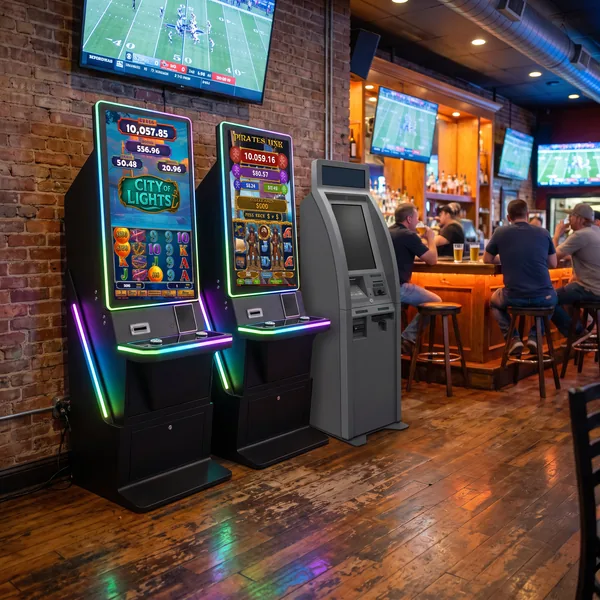
Foxfire is a route placement, built the same way: your out of pocket is zero, the operator provides the machines and the redemption kiosk, delivery and installation, service and maintenance, and collections and reporting. You provide the floor space, a standard 120V outlet, and staff who know what is on it.
A standard install is two machines plus a kiosk, about six feet by two feet, roughly twelve square feet along a wall that was already earning nothing. One machine alone is about two feet by two feet. Setup cost to you is zero. Maintenance cost to you is zero.
Foxfire is a no-chance video game system. The outcome is predetermined and shown to the player before they pay, so the element of chance is removed entirely. No RNG. No PRNG. No stochastic process. Zero. Eclipse Compliance Testing, an independent accredited lab used by state gaming authorities and the lottery industry, reviewed the source code and confirmed it. Their verdict, word for word: "This device is not a slot machine." Foxfire systems are certified legal in all 50 U.S. states.
We will not hand you a flat monthly number either, and now you know why that is the honest answer rather than a dodge. What we will do is walk your floor, count your traffic with you, and show you the same multiplication this article just walked you through, built from your own room instead of somebody else's guess. If you want the contract side of this conversation first, how revenue share machine placement works, and what "no cost" really means covers what a standard agreement actually asks of you. If your real problem is a slow night rather than an empty corner, why weeknights are the biggest untapped revenue in a neighborhood bar does that math. And countertop games for bars covers the placement basics if you are still deciding what belongs on your wall at all. How it works covers the Foxfire arrangement itself, start to finish.
A number you cannot check is not information. It is a sales pitch with a decimal point. Ask for the multiplication instead, and you will know within a week whether a placement is worth your wall.