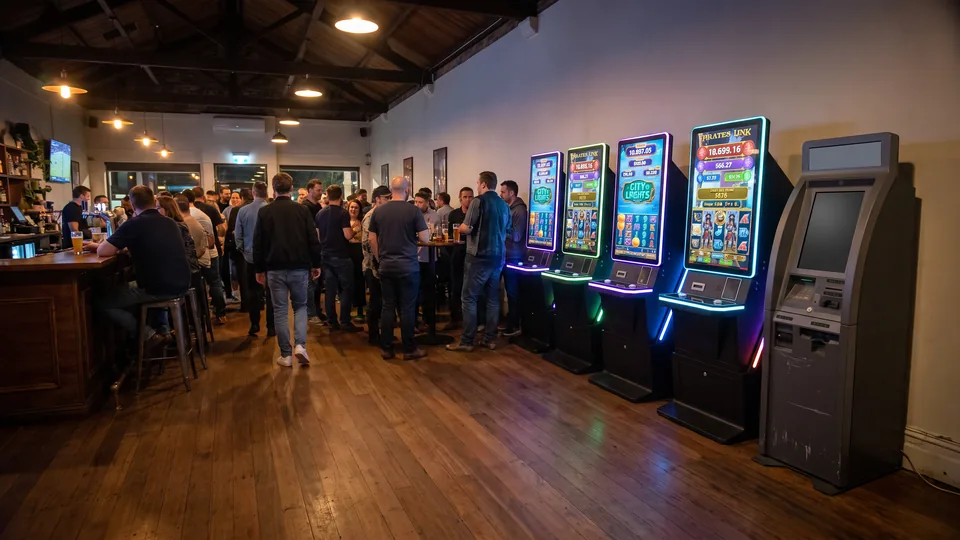
What is a countertop game, exactly?
It is a small touchscreen cabinet that sits on the bar top and takes money from whoever is sitting in front of it. That is the whole object. Lucky Coin, a route operator, describes its counter top units as carrying "over 100 different games, a large HD touchscreen, and even a bill acceptor". At the commercial end, BMI Gaming lists the JVL Echo countertop with "more than 150 games" and a 22 inch HD widescreen monitor.
Here is the part that trips people up. The phrase covers two completely different offers. One is a hardware sale, where you buy the box and it is yours. The other is a placement, where an operator brings you the box and keeps owning it. Both show up in the same search results. They are not the same decision, and the second one is how most bars actually get a game.
How does a placement deal actually work?
The operator owns the machine and you own the space it sits on. Everything else follows from that. The operator buys the cabinet, delivers it, installs it, services it when it breaks, collects from it, and reports what it took in. You provide the counter space, a standard wall outlet, and staff who know what the thing is and how to answer a question about it.
The income gets shared. How it gets shared is the question, and you have to ask it out loud. Some operators publish their terms. Lucky Coin says on its own site that it will place a game "at virtually no cost to you", that placements "include installation, maintenance, and 24/7 service free of charge", and that it "will maintain the games and split the revenue equally with the location on an agreed upon basis".
Plenty of others say call for pricing and stop there. That is not a warning sign by itself. It tells you the number is negotiable and that you are expected to negotiate it. If you want the longer version of what a first install actually involves, we wrote it up in what it takes to add a game machine to your bar. If your room is a restaurant rather than a bar, the same arrangement plays out across different hours, and we walked through it in amusement machines for restaurants.
Should you just buy the machine yourself?
You can, and for most single location bars it is the worse deal. Buying means the cabinet is yours, the income is all yours, and so is everything that goes wrong with it at nine on a Friday night.
Here is what an operator grade placement actually costs. A Foxfire class cabinet runs about $6,700. A standard placement is two cabinets plus the redemption kiosk where a player cashes out, and then you add freight, install and any electrical work the room needs. Buying that outright lands near $20,000 before one person has played anything.
The kiosk is the cost nobody budgets for. It only works if there is money in it, so you fund that float yourself, out of your own account, and you top it up every week it gets used. That is your cash sitting in a box in your own building. Under a placement the operator funds it, fills it, and carries the shortfall if a good week empties it early.
The prices are public at the low end, and that number is the one that misleads people. Arcades Market lists a bar top multi game cabinet at $1,085.00, or $1,115.00 with shipping insurance, and that listing carries no standard warranty statement. That is a consumer grade box. Operator grade hardware is quoted on request, which is why BMI Gaming lists the JVL Echo at "$ CALL !" for both the coin and non coin models.
So the buy route starts with five figures leaving your account before one person has played anything. JVL, which manufactures these machines, describes the same trade in its own words. Revenue share means "a third party installs the machine at no upfront cost" and carries "no risk if the machine underperforms in its first months". An upfront purchase means the business "owns it entirely, and keeps 100%", after what JVL calls "a meaningful investment for a quality machine". Here is that comparison in the terms you actually care about.
| Question | You buy it | It is placed |
|---|---|---|
| Cost today | About $20,000 | $0 |
| Cash to load the kiosk | Yours, topped up weekly | The operator's |
| Who fixes it | You | The operator |
| Who buys parts | You | The operator |
| Risk if it sits idle | Yours | Shared |
| Your cut per play | All of it | What you negotiate |
| Getting it out | Resell it | Per the exit clause |
Two rows there matter more than the rest. Buying wins on your cut and loses on the risk, because the money is gone whether the machine gets played or not. Placement moves that risk to the party that can spread it across a lot of rooms. That is why it became the category norm, and why the cost today column reads $0.
One caution on the buy column. The $1,085.00 listing is a consumer grade unit and is not what an operator installs, so do not plan against it. The figure near $20,000 covers a standard two cabinet placement with its kiosk, freight and install, and your own number moves with your state, your room and whatever the electrician finds. Get it quoted in writing before you plan around it.
What does a game on the bar actually do for the room?
It gives someone a reason to stay for one more. That is the mechanism, and the operators say so plainly in their own sales copy. Lucky Coin pitches a counter top game as giving customers "a great reason to hang around the bar area a little while longer, eat a little more, and drink a little more".
Time on premises tracks spend. Analytics from Path Intelligence, cited by Nutmeg, found that increases in average daily dwell time of just 1% were associated with increases in daily sales of 1.3%. That is a general retail and hospitality principle rather than bar specific data, so treat it as a direction, not as a forecast for your room.
There is a second effect worth knowing about. Annika Stensson of the National Restaurant Association told rd+d Magazine that "adding gaming elements can also bring in business from local leagues that hold regular tournaments", and that younger customers "tend to put premium value on social and interactive activities when visiting restaurants". Michael Auger of Trifecta Management Group put the space argument in one sentence in the same piece: "This is a platform to differentiate the experience and take advantage of the square footage."
What should you check before you give up the counter space?
Five things, and get all five in writing before anything gets installed.
- What is the share, and when can it change? A number said across the bar is not a term. It belongs in the agreement.
- Who services it, and how fast? Ask for a response window in hours. "We take care of it" is not an answer.
- How do you see what the machine took in? Ask to look at a sample report before you sign anything.
- What is the term, and how do you get out? Auto renewal and exclusivity clauses are where owners get stuck for years. We read the trade's standard form clause by clause in how revenue share placement works, and what "no cost" really means.
- What is the machine, legally, and who says so? Ask for certification from a named independent lab, on paper.
That last one gets skipped the most and costs the most. Our list of questions to ask any entertainment vendor goes through all five in detail, with a printable comparison sheet you can fill in while a rep is sitting in front of you.
Where does a no-chance system fit?
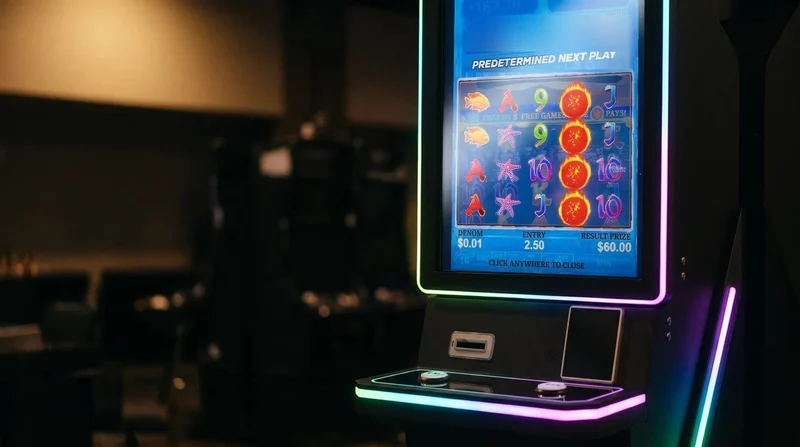
If question five is the one keeping you up, that is exactly where a no-chance system sits. Foxfire is a no-chance video game system. The outcome of every play already exists and is shown on screen before any money goes in, so there is no chance involved anywhere in it. Eclipse Compliance Testing, an independent laboratory accredited to ISO/IEC 17025 and 17020 and used by state gaming authorities, reviewed the source code and stated its verdict word for word: "This device is not a slot machine."
The placement side works the way this article describes. Foxfire provides the machines and the redemption kiosk, the delivery and installation, the service and maintenance, and the collections and reporting. You provide the space and a standard 120V wall outlet. Setup is $0 and maintenance is $0.
On space, one machine is about 2 ft by 2 ft. A full standard install is two machines plus the redemption kiosk, about 6 ft by 2 ft, which works out to roughly 12 square feet. If you want to measure that against your own floor before you talk to anyone, start with how much floor space entertainment equipment actually needs, or read how the system works end to end. The bars and clubs page covers how placement fits a bar.