How much floor space does a game machine actually need?
Usually a lot less than you picture. The machine most bars run is a countertop unit that sits on the bar itself. A common one, the JVL Echo iTouch HD3, measures about 21 inches wide and 15 inches deep and weighs 42 pounds (Game Room Guys). That is roughly the footprint of a cash register. It does not cost you a single seat.
Full standing cabinets are a different story. A showpiece like Raw Thrills' Space Invaders Frenzy runs 68 inches wide and 100 inches deep (Raw Thrills), so that one is a real floor commitment. Most bar placements are not that. They are a countertop unit, or a single slim upright tucked into a corner that was already dead space.
Do you need special electrical work?
No. Almost every one of these machines runs on standard 120-volt power and plugs into a normal wall outlet. Most use a standard 15-amp outlet, and only high-draw machines call for a 20-amp one (Player One Amusement Group).
The draw is small. A full-size cabinet like the one above pulls about 5 amps at 120 volts (Raw Thrills), less than a mini fridge. For one machine you do not need an electrician or a new circuit. You need a free outlet. If you plan to run several on the same strip, ask your operator to check the circuit load, but a single unit is a plug-in.
Who installs it, and who fixes it when it breaks?
The vendor does both, under a setup called the route model. Route operators place coin-operated machines in venues like bars and restaurants, then service and collect on them. The industry has worked this way since 1948 (Vending Times).
The division of labor is simple. You provide the space and the foot traffic. The operator provides the machine and keeps it running at no upfront cost to you (Emerson Amusements). When a screen freezes or a bill reader jams, you make one call. It is their equipment, so the repair, the parts, and the labor are theirs too.
What does it cost you to put one in?
Typically nothing up front. In the route model, the operator supplies the machine at no upfront cost, and the two of you share what it brings in (Emerson Amusements). The exact split varies by operator and by machine, so get the terms in writing before you sign, and read how long the agreement runs.
Here is the clean version of who handles what.
| On you (the venue) | On the operator |
|---|---|
| Provide the floor or counter space | Supply the machine |
| Provide a standard power outlet | Deliver and install it |
| Confirm the local permit | Service, clean, and repair it |
| Bring the foot traffic | Collect and split the revenue |
Do you need a permit or license for it?
Often yes, and this is the one part that lands on you. Many states and cities require an annual permit or decal for each coin-operated amusement device. Illinois, for example, taxes every such device and requires a decal on each machine that expires every July 31 (Illinois Department of Revenue).
Rules vary by state and even by city, so this is not something to guess at. Ask your operator which permit they register and which one is yours, then confirm it with your local clerk. Treat this as a checklist item, not a legal opinion. Nothing here is legal advice for your specific venue. Much of that classification question comes down to how the machine determines its outcome, which we cover in predetermined outcome vs random outcome and what the difference means legally.
How do you know if your bar is a good fit?
If you have regulars and any underused floor or counter space, you are probably a fit. Bars have hosted these machines for decades, and the coin-op amusement sector is large, about 6.0 billion dollars across roughly 7,113 businesses in 2026 (IBISWorld). None of that requires a remodel.
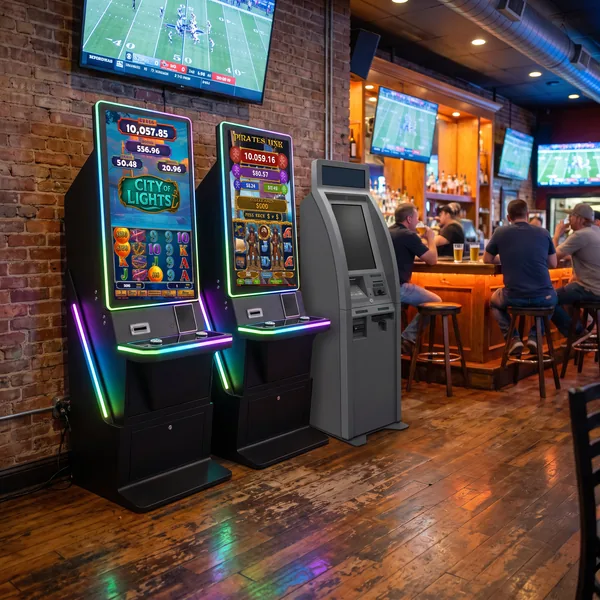
The better question is what a machine earns on your slow nights, which is where placement actually pays. If your Tuesday is quiet, that is the opening, and it is the subject of why weeknights are your biggest untapped revenue. Foxfire places a no-chance video game system on the same route model described here, so the space, the power, and the upkeep work exactly as above. You can look at the fit for bars and clubs, or read how placement works, before you talk to anyone.