Why are weeknights so much slower than weekends?
Habit, mostly. People default to Friday and Saturday for going out, and the whole market trains them to. It shows in the booking data. At full-service restaurants, Saturday drew about 27 percent of reservations and Friday about 21 percent in 2024 (Toast). That is a demand skew, not a rule about your bar, but it matches what your own week looks like.
The pattern is not fixed, though. Since the shift to hybrid work, downtown restaurant and bar sales came back to pre-pandemic levels first on Tuesdays, Wednesdays, and Thursdays (CNBC, citing WFH Research). Midweek is where behavior is actually moving. That is the opening.
Why is weeknight revenue worth more than it looks?
Because your fixed costs are already paid. Rent, insurance, and base labor do not fluctuate with how busy you are on a given night (Toast). You owe the same rent on a dead Tuesday as on a full Saturday.
That changes the math on every extra guest. Bars run a high gross margin, roughly 70 to 80 percent at a typical 20 percent pour cost, but only 10 to 15 percent net profit, because rent, staff, and utilities eat the difference (Toast). On a slow night those overheads are already covered by being open. So the next guest through the door converts much closer to that 70 to 80 percent gross margin than to the thin blended net. Weeknight traffic is your highest-margin traffic.
What does a full weekend really cap out at?
Seats and time. A packed Saturday can only hold so many people and turn the room so many times. Once you are full, more demand does not become more revenue. It becomes a wait, or a walk-out.
Your weeknight has no such ceiling. The seats are empty and the staff is already scheduled. Growth from an already-busy night is capped. Growth from an empty one is not. That is why the slow night, not the busy one, is where your next dollar of profit actually lives.
How much does one more Tuesday guest really add?
More than most owners assume, because the cost of serving them is small once the doors are open. Here is a worked example. The numbers are illustrative, not Foxfire figures, and the only sourced input is the roughly 20 percent pour cost above.
| Same bar, two Tuesdays | Slow Tuesday | 20 more guests |
|---|---|---|
| Guests | 20 | 40 |
| Sales at 25 dollars a head | 500 dollars | 1,000 dollars |
| Fixed cost (rent, base staff, utilities) | already committed | unchanged |
| Variable cost (about 20 percent pour) | 100 dollars | 200 dollars |
The extra 20 guests brought in 500 dollars of sales. Only about 100 dollars of that is new cost, because your rent, your bartender, and your lights did not change. The rest, roughly 400 dollars, is contribution straight to the bottom line. On an already-full Saturday you could not seat those 20 people at all, so that 400 dollars simply does not exist there. It only exists on the slow night.
What actually brings people in on a slow night?
A reason that repeats. A neighborhood bar runs on regulars. Sociologist Ray Oldenburg named the neighborhood tavern a "third place," a spot apart from home and work that people return to because of the regulars and the welcome (Oldenburg, The Great Good Place, 1989). Regulars do not need a special occasion. They need a reason to pick Tuesday.
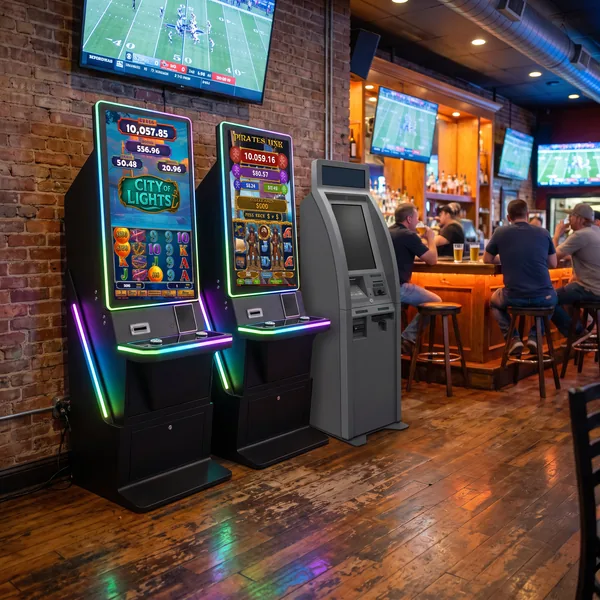
Recurring entertainment is one of the most reliable reasons. The National Restaurant Association points out that adding gaming can bring in business from local leagues that hold regular tournaments, and that younger customers put real value on social, interactive activities (rd+d Magazine). It also keeps people in their seats longer, and in retail and hospitality analytics a 1 percent rise in dwell time tracks with about a 1.3 percent rise in sales (Nutmeg, citing Path Intelligence). The midweek appetite is already there: Toast Tables reported Tuesday reservations up about 15 percent and Thursday about 12 percent year over year, the biggest gains of any day (Toast). Bringing someone in is only half the equation. What they spend once they arrive climbs with every extra minute they stay, which is its own math we walk through in how to get customers to stay longer.
Where does entertainment fit?
It gives a regular a reason to pick your slow night, and it earns on the exact margin math above. A machine on your floor turns dead hours into the high-contribution traffic this whole article is about, without a bigger room or a bigger staff. That is the case for adding a game machine to your bar, which covers the space, power, and upkeep in plain terms.
Foxfire places a no-chance video game system on that same low-effort route model, aimed squarely at the weeknight opening. You can read how placement works before you decide anything.