Why is it harder to get people through the door than it used to be?
Because fewer people go out at all now, and the ones who do drink less when they get there.
The Bureau of Labor Statistics runs the American Time Use Survey every year. It asks thousands of people what they actually did with their day. The 2025 results came out on June 25, 2026, and one line in them explains most of your Tuesday.
On an average day in 2025, 30 percent of people aged 15 and over did any socializing and communicating at all. In 2015 it was 38 percent. The time they spent on it fell as well, from 41 minutes a day to 35.
That is not a vendor statistic. It is a federal survey measuring behavior, and it says the habit of going out to be around other people has thinned over a decade.
Gallup measured the other half of your night. In its 2026 Consumption Habits poll, published on August 20 by Lydia Saad, 54 percent of U.S. adults said they drink alcohol. That matches last year and it is the lowest reading in a Gallup trend running back to 1939. Drinkers reported an average of 3.2 drinks in the past week.
Put the two together and the picture is honest. Fewer people are heading out, and the ones who arrive order less. Neither of those is your fault, and neither one is fixable from behind the bar. What you control is whether there is a reason to pick your room.
What are you actually competing with on a Tuesday night?
A living room that got very good at being a bar.
The same survey found that Americans averaged 5.2 hours of leisure a day in 2025, and watching TV took 2.6 of them. Half of all the free time people have goes to a screen at home.
Think about what that room offers at seven on a Tuesday. The drink costs a fraction of what you charge for it. Nobody has to drive, and nobody has to find parking. The seat is already warm and the show is already queued.
You are not losing those two customers to the bar down the street. You are losing them to a room that costs nothing to sit in.
That changes the job in front of you. You will never beat the couch at being comfortable or at being cheap, so stop trying. You beat it on the one thing it cannot do, which is put your customer in a room with other people and give them something to do there.
What is one more guest worth on a slow night?
Almost all of it lands as profit, because you already paid for the night.
Rent, insurance, lights, and the bartender you scheduled are spent the moment you open the door. Four people or forty, that cost does not move. So somebody who walks in on a quiet Tuesday costs you very little beyond what goes in their glass.
Put numbers on it. Say a Tuesday brings you 18 guests at a $14 average check, and your pour cost runs at 25 percent. Those inputs are illustrative, written to show the shape of the math rather than to describe any real bar, so drop your own in. Each guest carries about $10.50 of gross margin, and the building was paid for before they arrived.
Now price the ideas everybody hands you. A band at $250 has to pull about 24 extra people through the door before it earns you a cent. A trivia host at $150 needs about 15. A boosted post at $60 needs about 6. Something that sits in your room and costs you nothing on the night is ahead on the first one.
None of that makes a band a bad idea. A band is a fine idea on the night it works. It just has to clear that bar again every time you book it, and something permanent clears it once.
What makes a reason strong enough to move someone?
Three things, and most bar promotions have one of them.
- It has a time. Nobody leaves the house for "sometime". They leave for seven o'clock on Wednesday.
- The couch cannot do it. If it is cheaper and easier at home, home wins.
- It is there on the weeks you plan nothing. A reason you have to rebook every week is a job you gave yourself.
Run the usual list through all three.
| The reason | Has a time? | Couch cannot do it? | There on an unplanned week? |
|---|---|---|---|
| Live music | Yes | Yes | No |
| Trivia night | Yes | Yes | Only while you keep booking a host |
| Happy hour | Yes | No. Drinking at home is cheaper | Yes |
| The game on the TV | Yes | Barely. Same broadcast at home | Only when there is a game |
| A dart or pool league | Yes | Yes | Yes, once the league runs itself |
| Something in the room to play | Always on | Yes | Yes |
The bottom two rows are the ones worth staring at. A league and a fixture both keep working after you stop pushing them. Everything above them stops the week you stop paying for it. No listicle of bar promotion ideas ranks them on that, and it is the property that decides whether a slow Tuesday gets better permanently or just once.
Your quiet nights may be the real problem underneath the traffic question. We did the margin math on those in why weeknights are the biggest untapped revenue in a neighborhood bar. And if people are coming in but leaving after one, that is a different lever, covered in how to get customers to stay longer.
Where does placed entertainment fit?
It is the reason that stays in the room after you go home.
Placed entertainment means an operator puts equipment in your building, services it, and shares what it brings in. Here is who does what.
| You provide | The operator provides |
|---|---|
| Floor space, about 12 square feet for a standard install | The machines and the redemption kiosk |
| A standard 120V wall outlet | Delivery and installation |
| Staff who know what is on the floor | Service, maintenance, and repairs |
| Collections and reporting |
Setup cost to you is zero. Maintenance cost to you is zero. That is what makes the bottom row of the table above possible, because nothing about it lands on your night in the first place.
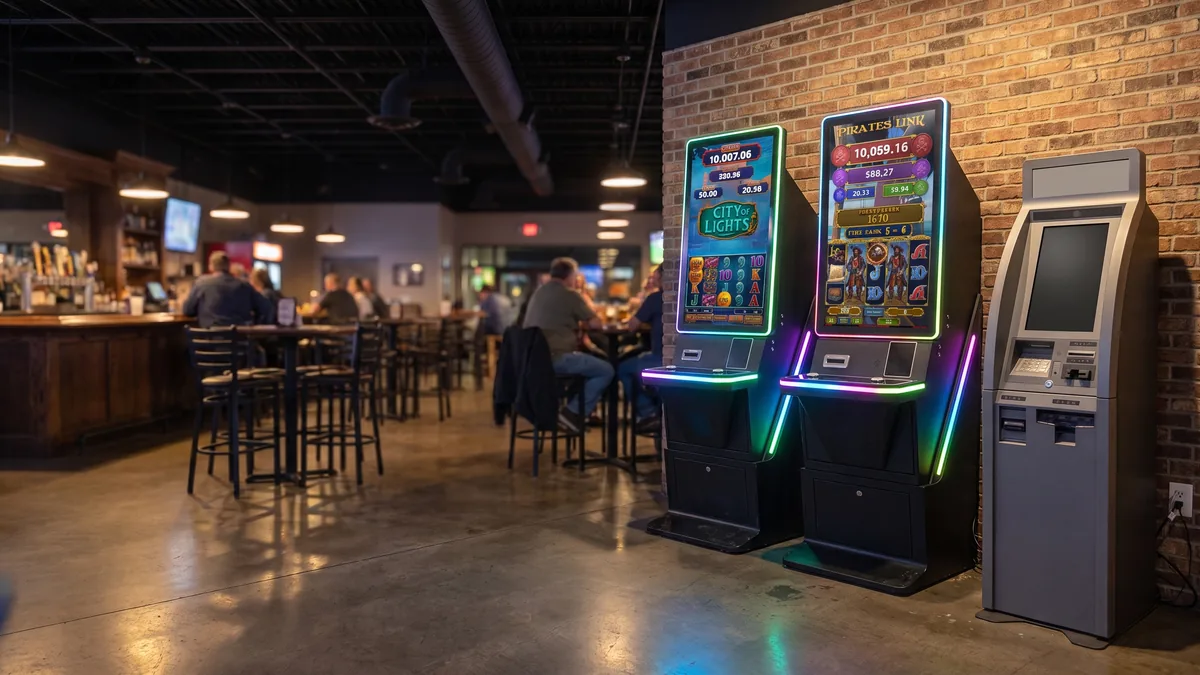
Space is the objection that ends most of these conversations, so take the numbers first. One machine measures about 2 feet by 2 feet. A standard install is two machines plus a redemption kiosk side by side, about 6 feet by 2 feet, or roughly 12 square feet in total. That is a corner, not a floor plan. If you want to measure your own wall before you talk to anybody, how much floor space entertainment equipment actually needs has the clearances.
What a placement returns comes down to three things. How many people are in the building. How often they play. How many machines are on the floor. The first of those is the one this whole article has been about, which is why a traffic problem and an entertainment decision are the same conversation.
Be exact about what the equipment is, because your regulars will ask and your staff should have the answer ready. Foxfire is a no-chance video game system. The outcome is predetermined and shown to the player before they pay, so the element of chance is removed. No RNG. No PRNG. No stochastic process. Zero. Eclipse Compliance Testing, an independent accredited lab used by state gaming authorities and the lottery industry, reviewed the source code and confirmed it. Their verdict, word for word: "This device is not a slot machine." Foxfire systems are certified legal in all 50 U.S. states. What your specific venue may operate is a question for your own counsel, and any vendor who answers it for you is telling you what you want to hear.
How it works covers the arrangement itself, start to finish.
None of this rescues a bar nobody likes. Fix the room first, because a reason to come in is worth nothing if the beer is warm and nobody says hello. But once the room is right, the cheapest traffic you will ever add is the person who came because there was finally something here worth the trip.