Why is bar and bottle revenue per guest sliding?
Ask a room that has run for a decade and the honest answer is that this is not a slow year, it is a different generation. Ian Chen, CEO of the ticketing platform Discotech, reported in Cater and Event Magazine that VIP table sales per customer are down roughly 40 percent from pre-pandemic levels. Venue partners are seeing the same slide in plain bar sales. His read is specific: guests are not skipping bottles because money is tight this month. They are drinking less as a lifestyle, the way an earlier generation smoked fewer cigarettes.
The national numbers back the shape of it, even outside nightlife. Gallup found that 54 percent of U.S. adults say they drink alcohol at all, a record low held for a second straight year in a trend the pollster has tracked since 1939. The federal government's own time use survey shows the same pullback in going out generally. On an average day in 2025, 30 percent of people 15 and older did any socializing, down from 38 percent in 2015, with minutes spent on it falling from 41 to 35. A room built to sell bottles to a crowd that goes out less and drinks less is fighting two trends at once, not one bad quarter.
What does that trend actually take out of a night?
Chen's own numbers point at something more specific than "spend less." Ticket sales per customer were up over the same stretch that VIP tables fell. Guests are still willing to pay to be in the room. They are just not funneling that willingness through the bar the way they used to, and a room built mainly to sell bottles and pours is not set up to catch spending that shows up somewhere else. The dollar did not leave the building. It moved to a channel the venue does not own the way it owns the bar.
What does every "revenue beyond the bar" list already tell a club to try?
Search for nightclub revenue streams beyond the bar and the answer set is consistent. A representative list published by an insurer serving the hospitality trade names seven lines. Cover charges and ticketed events. VIP and bottle service. Merchandise. Private events and venue rentals. Sponsorships and partnerships. Food offerings. Marketing or digital engagement. None of it is wrong. Cover charges, private events, and sponsorships are real money, and a room that is not running all of them well should start there before adding anything new.
But read enough of these lists and a pattern shows up. Every one of them is written by someone whose own product lives on the list: insurers, ticketing platforms, marketing agencies. Each writes from its own catalog, the same way a POS vendor's blog leans on point of sale features. That is not a criticism. It just means the list was never built by walking the floor of a room that has a corner to fill.
What is missing from every one of those lists?
Read the list again and notice what never appears on it. Not one line is placed entertainment: no arcade games, no amusement machines, nothing a guest plays rather than drinks or buys a ticket to. Nobody selling ATM placement forgot to mention ATM fees. Nobody selling ticketing forgot ticketed events. Placed entertainment is missing because none of the people writing these lists sell it, not because it does not belong on a nightclub floor.
| Revenue line | Asks the guest to spend more on drinks? | Needs staff time to sell it? | Needs capital or inventory up front? |
|---|---|---|---|
| Cover charges, ticketed events | No | Yes, door staff | No |
| VIP and bottle service | Yes, by design | Yes, dedicated staff | Yes, inventory |
| Merchandise | No | Yes | Yes, inventory |
| Private events, venue rentals | No | Yes, booking and staffing | No |
| Sponsorships, partnerships | No | Yes, sales relationship | No |
| Placed entertainment | No | No | No, the operator provides it |
Why does a line that does not touch drink spend matter more here than anywhere else?
A slow-Tuesday neighborhood bar and a nightclub losing bottle sales are both chasing revenue beyond the bar, but they do not have the same problem. The bar's weeknight is simply empty, so more traffic helps every line, the bar included. A nightclub losing VIP and bottle spend has a narrower problem. The room can be busy and the dollar per guest on alcohol still falls, because the falling number is competing against the very spend the room depends on.
A revenue line for a room in that bind has to clear a higher test than "it makes money." It has to not compete with the thing that is already shrinking. Cover charges and tickets already pass that test, which is why they sit on every list. Placed entertainment passes it the same way. Nobody chooses between another round and a play, because the two were never competing for the same dollar in the first place.
Where does Foxfire fit into that gap?
Foxfire places a machine the same way in a nightclub as in any other venue, at zero cost to you. Foxfire provides the machines and the redemption kiosk, delivery and installation, service and maintenance, and collections and reporting. You provide the floor space, a standard 120V outlet, and staff aware of what is on it. One machine measures about 2 feet by 2 feet. A standard install is two machines plus a kiosk, about 6 feet by 2 feet, roughly 12 square feet. It fits along a wall near the bar or in a lounge corner, and it never touches table count or the dance floor.
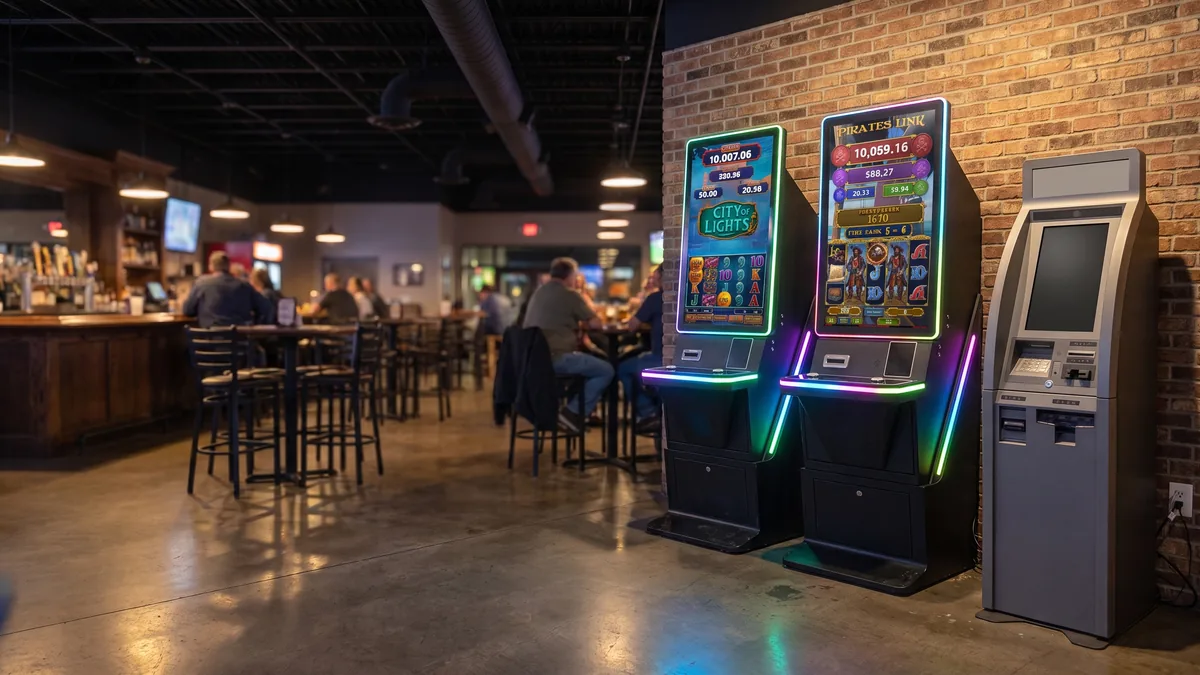
Each system is a no-chance video game system. The outcome is predetermined and shown to the player before they pay, which removes the element of chance entirely. No RNG. No PRNG. No stochastic process. Zero. Eclipse Compliance Testing, an independent accredited lab used by state gaming authorities and the lottery industry, reviewed the source code and confirmed it. Their verdict, word for word: "This device is not a slot machine." Foxfire systems are certified legal in all 50 U.S. states.
The rest of the beyond-the-bar list is worth running well, and none of it should stop. This is simply the one line on it that was never trying to compete with your bar to begin with. If you want the agreement side of a placement before you add one, how revenue share machine placement works, and what "no cost" really means covers what you sign. If your room has not added anything like this before, countertop games for bars covers the placement basics. And how much money do bar game machines make? walks through the formula that actually decides what a placement returns.