Why is your canteen revenue falling faster than your membership?
Because you are losing visits twice over. The roster gets shorter, and the members still on it come in less often than they used to. One of those is a recruiting problem. The other is not.
The recruiting side is well documented. American Legion Post 96 in Cicero had more than 400 members around World War II and now has fewer than 100. Auxiliary officer Balvina Ranney put about 75 percent of the members it has left in their 40s, 50s or 60s. Jessica Mordacq reported both in the Riverside-Brookfield Landmark in May 2024. In West Virginia, Legion membership fell from 27,000 across 114 chapters in 2000 to 10,700 across 112 chapters, according to the Hampshire Review in October 2025. Roughly the same number of buildings. Less than half the people.
The visit side gets talked about less. Joe Bartley, the Illinois VFW state adjutant-quartermaster, put it plainly to the Landmark: "Some of these people are at the point in their time when they just want to sit back in the recliner and enjoy life." A member who renews and stops coming in still counts on your roster. They do not count at your register.
What two numbers actually make up your canteen revenue?
Visits, and spend per visit. That is the entire equation, and membership only touches the first one.
More people come, the same people come more often, or events bring in people who were never on your roster. Spend per visit goes up when the room has more worth spending on.
The cost side is what makes those levers worth pulling. Toast, writing on restaurant costs in November 2024, draws the line simply. Fixed costs like rent and insurance stay stable. Variable costs like food and hourly labor move with sales. A post building is mostly the fixed kind. Insurance, utilities and upkeep charge the same on a quiet Wednesday as on a busy Friday. These are also old buildings. North Penn Now reported in December 2025 that many Legion halls need roof replacements, ADA upgrades, HVAC systems or fire suppression work. The Lansdale Post 206 building dates to 1920.
So your shortfall is a fixed number, and the margin on every extra visit drops straight against it. That is also why a bad year at the bar hurts everything else. Gregory Walker, commander of American Legion Post 838 in Maywood, told the Landmark his post makes 90 percent of its revenue from the canteen. That is one commander describing one post, not a national average. It still shows how much weight the room carries.
What happens when the canteen starts losing money?
It stops funding the post and starts consuming it. That is not a hypothetical. It happened on the record last year.
American Legion Post 91 in Romney, West Virginia closed its Cantina in October 2025. Post commander Ken Maiers told the Hampshire Review it was operating at a $2,000 a month loss. Under his leadership the post had raised $6,000 through small fundraisers, and in his words, "every penny of that went into the Cantina." Read that twice. The fundraising was not paying for veterans programs. It was paying for the bar. "I didn't come here to be a bar manager or run a canteen," Maiers said. For years the post could not run its programs, because the money kept going back into a room that lost money every month.
The other number in that story is the one to sit with. Post 91 has some 220 members. About half a dozen veterans are active in club affairs, plus roughly five each from the Sons of the Legion and the Auxiliary. A roster of 220 and a working crew of about sixteen. That constraint decides which fixes are real.
How many extra visits does it take to close a gap like that?
Fewer than you would guess, and far fewer than the number of new members it would take. Here is the arithmetic on a $2,000 a month hole.
Drink margin is the friendly part of this business. Toast put the average pour cost between 15 and 28 percent in November 2024, which leaves roughly 80 cents of every drink dollar before the room's other costs. The table below uses 75 cents to stay conservative. The spend levels are illustrative, not data from any post.
| Average spend per visit (illustrative) | Margin per visit at 75 percent | Extra visits a month to cover $2,000 | Extra visits a day |
|---|---|---|---|
| $8 | $6.00 | 333 | About 11 |
| $12 | $9.00 | 222 | About 7 |
| $18 | $13.50 | 148 | About 5 |
Now hold that against recruiting. Eleven extra visits a day is not eleven new members. If thirty of the regulars you already have came in one extra time a week, that is about 129 additional visits a month. At the middle row of that table it covers well over half the gap. Same roster. Same volunteers. More visits.
That is the case for working the visit side first. New members are slow, uncertain, and mostly outside your control. Visits are none of those things.
Which lever can you move without more members or more volunteers?
Spend per visit, because it does not require getting one more body through the door. It is also the lever most canteens have never really touched.
The usual answer is events. Bartley told the Landmark that many VFW posts are leaning harder on fundraising, with dinners and raffles often held in the same building as the canteen. Fundraisers work. They also spend the resource Post 91's numbers show you have least of, which is volunteer hours. A dinner needs a crew. A raffle needs a crew. A room that gives people a reason to stay another hour does not.
So the question becomes what you can put in the room that earns while nobody works it. Hall rentals do that. So does a jukebox or a pool table. Placed entertainment does too, and it costs the post nothing to bring in.
What does placed entertainment ask of the post?
Space, an outlet, and staff who know what is on the floor. That is the list.

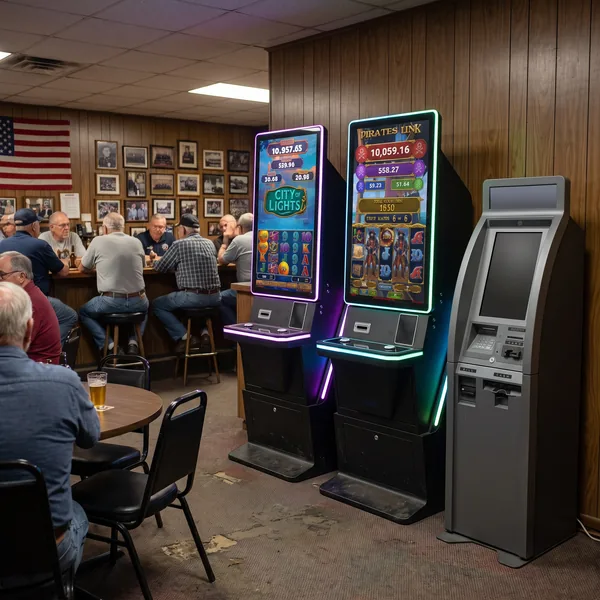
A Foxfire machine measures about 2 feet by 2 feet. A standard install is two machines plus a redemption kiosk, about 6 feet by 2 feet in total, or roughly 12 square feet. It runs off a standard 120V wall outlet. Setup cost to the post is zero, and so is maintenance. The operator handles delivery, installation, service, collections and reporting.
What it returns comes down to three things: how many people are in the building, how often they play, and how many machines are on the floor. Notice what is not on that list. Member count is not on it. Neither is volunteer time. A shrinking roster with a busy Friday still does well here.
Be precise about what the equipment is, because your committee will ask first. Foxfire is a no-chance video game system. The outcome is predetermined and shown to the player before they pay, so the element of chance is removed. Eclipse Compliance Testing, an independent accredited lab used by state gaming authorities and the lottery industry, confirmed that at source-code level. Its verdict, word for word: "This device is not a slot machine." Foxfire systems are certified legal in all 50 U.S. states.
What that certification does not do is tell you what your post may operate. Veterans and fraternal organizations sit under their own rules, and those rules vary by state. Note who actually signs, too. North Penn Now explained that many posts run the property and the bar through a separate home association, because the post cannot directly run a bar under state law. Whoever holds the license and the building signs, and your counsel should read it first. The longer version of who provides what is in how veteran and fraternal clubs add revenue without raising dues.
What do you bring to the house committee?
Two numbers and one page. Committees do not approve ideas, they approve arithmetic they can check.
- Your visits and your average spend per visit for the last twelve months. Most registers will give you both.
- What the room costs whether anybody comes in or not.
- The gap between those two, written as one monthly number.
- What the operator provides in writing, and what the post owes up front and monthly. On a placement agreement the honest answer to both is nothing.
- The documentation that comes with an install, so your counsel can read it before anyone signs.
If the committee is where your ideas keep stalling, non-dues revenue a post committee can actually approve scores the usual options against what your own bylaws let a committee sign off on. If you want the vendor questions in full, we wrote those up in what venue owners should ask before signing with any entertainment vendor. If your real problem is quiet nights rather than a shrinking roster, why weeknights are the biggest untapped revenue does that math. And how it works covers the placement model. To see how placement fits a post, start with the veterans and fraternal clubs page.