Why do good revenue ideas die at your post?
Because the meeting is the hard part, not the idea. Your post already has a list. What it does not have is an idea that clears its own approval rules.
You can find twenty non-dues revenue ideas in ten minutes. Almost all of that writing is aimed at trade associations with paid staff, so it talks about certifications and sponsorship decks. None of it knows what a house committee is.
Your problem is not a shortage of ideas. Every idea has to survive your post constitution before it ever meets a customer. So work the approval rules first, then pick the idea that fits them.
What do your own bylaws say about a new source of revenue?
One line usually settles it, and that line does not name you.
Whitehurst-Ware Post 539 in New Bern, North Carolina puts it this way in Article VII of its constitution: "The revenues of this Post shall be derived from annual dues of membership and from such other sources as may be approved by the Post Executive Committee." Douglas V. Passen Memorial Post 35 in Mount Dora, Florida carries nearly the same sentence, pointing at its executive committee.
Guy C. Parlett Post 7 in Annapolis, Maryland goes further. Its revenue "shall be derived from membership dues and from such other sources as may be approved by the members of the Post." At that post a new revenue line is a floor vote, not a committee call.
Read your own version before you do anything else. It tells you who you are actually selling to, and it is usually not the person you have been talking to.
How much can your committee spend without going to the floor?
Less than most officers expect, and the number is written down in your own bylaws.
Four posts, four public rule books, four different ceilings:
- Post 539, New Bern, North Carolina. Any unbudgeted expense over $200 must go in writing to the Finance Committee before that committee will even recommend it to the Executive Committee.
- Post 35, Mount Dora, Florida. "Any expenditure in excess of $200.00, other than normal operating, or in an emergency shall first be approved by the membership at a regular or specially called Post 35 meeting."
- Edward W Thompson Post 49, South Haven, Michigan. A committee lead may make "a single expenditure of up to $750" for an immediate repair. Beyond that the Executive Committee "shall authorize and approve all expenditures."
- Post 155, Naples, Maine. The House Committee, through the Facility Manager, may "spend up to two thousand ($2000.00) on capital expenditures without prior Executive Committee approval."
So the practical ceiling sits between $200 and $2,000. Now price the usual ideas against it. A used pool table, a sound system, a walk-in cooler, a set of cabinets. Every one clears every one of those ceilings. Which means every one is a motion, a second, a vote, and a wait for the next meeting.
Who is actually left to run the fundraiser?
Fewer people than your roster says.
The Hampshire Review reported on American Legion Post 91 in Romney, West Virginia in October 2025. The post claims some 220 members. Commander Ken Maiers told reporter Andy Prutsok that only about half a dozen veterans, plus about five each from the Sons of the Legion and the Auxiliary, are active in club affairs. Call it sixteen people carrying a 220 member post.
Those sixteen raised $6,000 through various small fundraisers after Maiers returned to the commander's chair. That is real work and it is roughly $375 raised per active person. Now ask what it would take to double it. You would need the same sixteen people to do it all twice.
Maiers named the shortage himself, and it was not cash. "We don't need financial help, but if somebody with some knowledge could help us do fundraising that would be a huge benefit," he said. He is asking the community for fundraising expertise, not donations.
The official playbook asks for the same scarce thing. The VFW Foundation's fundraising guidance for posts, written by foundation manager Richard Freiburghouse and posted by the VFW Department of New Hampshire, is a solicitation program end to end. Build a donor list from the largest employers in your county. Ask your utilities and your own beverage distributor. Chase local foundation money through a bank trust officer. Hand every prospect a one page sheet of what the post does for its town. It also warns that there are few if any federal grants applicable to VFW posts, and tells posts flatly: "do not consider federal grants as a fundraising option."
It is good advice. It also ends with the honest part: "To succeed you will have to dedicate yourself to this cause and naturally expend a fair amount of effort." Effort is exactly what sixteen people have least of.
What four tests does an idea have to pass?
Money up front, volunteer hours, reversibility, and who has to sign. All four come out of the bylaws above, not out of an opinion.
| Test | The question | Where it comes from |
|---|---|---|
| Money up front | More than the committee may approve alone? | The $200 to $2,000 ceilings above |
| Volunteer hours | Who works it, every week? | Post 91's sixteen active members |
| Reversibility | Can you pull it back out in ninety days? | What the post buys, the post owns |
| Who signs | Committee, or the full membership? | Posts 539 and 35, versus Post 7 |
An idea that fails one of these is not a bad idea. It is a slow one. It goes on the agenda, it waits for a quorum, and it competes with the roof.
Which of the usual ideas pass, and which do not?
Most of the list fails on the same test, which is volunteer hours.
| Idea | Money up front | Volunteer hours | Reversible | Who approves |
|---|---|---|---|---|
| Raise dues | None | Low | No | Varies by bylaws |
| More hall rentals | Low | High, every booking | Yes | House committee |
| Dinners and raffles | A food float | Highest on the list | Yes | House committee |
| Donation drives | None | High, needs a skill | Yes | Executive committee |
| Buying equipment yourselves | Over every ceiling | Moderate, plus repairs | No | Membership vote |
| Placed entertainment, revenue share | None | None | Yes | Executive committee |
Two rows deserve a footnote. Dues are not always a floor vote, since Post 35 in Mount Dora sets its dues by executive committee, so read your own clause. And equipment you buy is equipment you own, which means the repair bill is yours too.
Now read the bottom row against the rest. It is the only line that asks nothing of the ceiling and nothing of the sixteen people. That is why it is the one a committee can approve in a single meeting.
What does placed entertainment ask of the post?
Space, an outlet, and staff who know what is on the floor. That is the list.
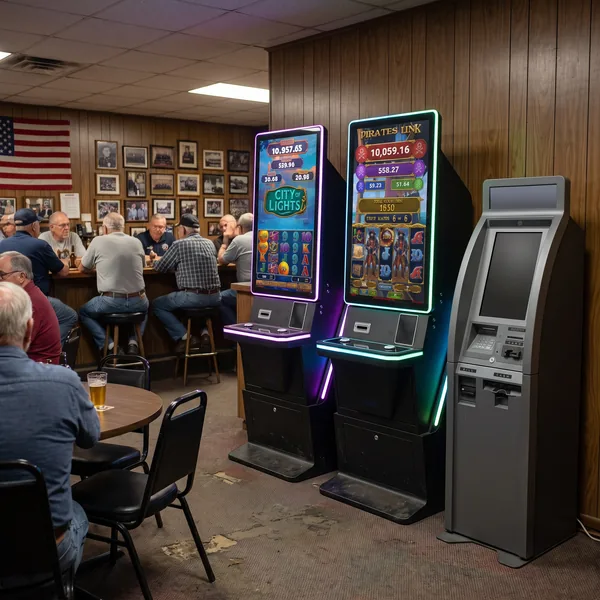
A Foxfire machine measures about 2 feet by 2 feet. A standard install is two machines plus a redemption kiosk, about 6 feet by 2 feet together, or roughly 12 square feet. It runs off a standard 120V wall outlet. Setup cost to the post is zero and so is maintenance. The operator handles delivery, installation, service, collections and reporting. If you want the footprint conversation in detail, it is in how veteran and fraternal clubs add revenue without raising dues.
What it returns comes down to three things. How many people are in the building, how often they play, and how many machines are on the floor. Member count is not on that list. Neither is volunteer time. A post with a shrinking roster and a busy Friday still does fine here, which is the same point the canteen math makes in how to increase canteen revenue when membership is falling.
Be precise about the equipment, because that is the first thing your committee will ask. Foxfire is a no-chance video game system. Every outcome is set in advance, and players can preview it before every play, so the element of chance is removed. Eclipse Compliance Testing, an independent accredited lab used by state gaming authorities and the lottery industry, reviewed the source code and found no random number generator. Its verdict, word for word: "This device is not a slot machine." Foxfire systems are certified at the source code level.
What that certification does not settle is what your post may operate. Veterans and fraternal organizations sit under their own rules and those rules vary by state, so your counsel reads the agreement and the documentation before anybody signs.
What do you put in front of the committee?
One page, in the order your bylaws ask for it.
- The clause. Quote your own line on other sources of revenue, so nobody spends the meeting arguing about whether the committee may act at all.
- The ceiling. Your post's unbudgeted spending limit, next to the fact that this asks for nothing against it.
- The four tests, scored, for every option you are comparing. Not just the one you like.
- What the operator provides in writing, and what the post owes up front and monthly.
- The exit. How the equipment leaves, and how much notice that takes.
- The documentation that comes with an install, so counsel can read it first.
Before you sign anything, run the vendor through the questions worth asking any entertainment vendor, and read how placement works so you can answer the committee without calling anyone back. For a 55+ or HOA clubhouse, how a community funds a clubhouse upgrade without raising dues walks through the same logic. The veterans and fraternal clubs page covers the venue side for a post.
Committees do not approve enthusiasm. They approve arithmetic they can check, on paper, in one meeting.