What counts as dead floor space in a restaurant?
Any square footage you pay rent on that produces nothing and, in its current state, never will.
You already know where yours is. The corner past the last booth that holds a plant and a stack of highchairs. The bench by the host stand where people wait and do nothing. The run of wall between the restrooms and the back hall. The end of the bar that only fills on a Friday.
Dead space is not the same thing as back of house. Your walk-in does not sell a single plate and you would be closed inside a week without it. Aisles, the server station, the restrooms and the kitchen all earn their footage indirectly. Dead space is different. It is the footage that is neither selling nor supporting a sale. It is just there, on the lease, every month.
Why does an empty corner cost you money?
Because occupancy cost is fixed, and fixed means it does not shrink when part of your room does nothing.
Toast splits restaurant costs into fixed and variable, and puts occupancy squarely in the fixed column. In its cost guide, Justin Guinn writes that fixed costs are the ones not tied to sales, and that "your lease and your insurance premium remain the same from month to month," while the cost of a case of tomatoes changes week to week. Lease or mortgage payment, insurance premiums and taxes are all listed there as fixed.
So the corner bills you whether it works or not. That is the same argument a slow Tuesday makes, only on the space axis instead of the time axis. We ran the time version of it in why weeknights are the biggest untapped revenue in a neighborhood bar.
The pressure on that room has gone up, too. The National Restaurant Association's 2025 Off-Premises Restaurant Trends report found that nearly 75% of all restaurant traffic now happens off-premises, and that off-premises makes up a larger share of sales for 41% of full-service operators than it did in 2019. Your dining room is carrying a smaller slice of your business than it used to carry.
Operators are not writing the room off, though. Restaurant Dive, reporting on the association's State of the Industry Report 2025, found that 90% of fine dining operators and 60% of quick-service operators said on-premises visits would matter more to them in 2025 than off-premises. The room still has to work. It just has fewer feet doing the work.
How do you put a dollar figure on that space?
Three lines of arithmetic, using two numbers you already have: your annual occupancy cost and your square footage.
Toast's benchmark guide, written by Tessa Zuluaga, puts occupancy cost at "around 5-10% of your total sales after tax," and notes the figure moves with size and location. Take a restaurant sitting in the middle of that range. Every input below is illustrative, chosen to make the math readable. Use your own.
| Step | Illustrative input | Result |
|---|---|---|
| Annual sales | $720,000 | |
| Square footage | 2,400 sq ft | |
| Occupancy cost at 8% of sales | 0.08 x $720,000 | $57,600 a year |
| Occupancy cost per square foot | $57,600 / 2,400 | $24 per sq ft, per year |
| The dead corner, 12 sq ft | 12 x $24 | $288 a year |
Two hundred and eighty eight dollars. That is the literal answer to the question in the headline, and it is small enough that most owners stop reading right here.
Do not stop. The rent is the wrong number.
What is that space worth if it actually worked?
About twelve times more, because what the corner costs you is not the same as what it should be producing.
The metric for that is sales per square foot, and the same Toast benchmark guide gives both the formula and the bar. Annual sales divided by total square feet. For full-service restaurants, Toast puts the target at a minimum of $150 per square foot, and limited service at $200.
Run the illustrative restaurant through it. $720,000 divided by 2,400 square feet is $300 per square foot. That is double the floor Toast names, so this is a healthy room, not a struggling one.
Now hold the corner against it. At $300 per square foot, twelve square feet of average floor carries about $3,600 in sales a year. The dead corner carries zero.
That is the number worth caring about. Not $288 of rent. About $3,600 of yield the room is capable of and is not producing. Call it the yield gap.
One honest qualifier, because you will spot it anyway. No restaurant gets its average out of every square foot, and no restaurant should try. The walk-in, the aisles and the restrooms will never sell anything. The question is narrower than the whole floor plan. Of the space that could be working, how much of it is not, and what would it take to change that?
To answer that across the whole room rather than one corner, splitting your square footage into selling space and support space gives you a sales per square foot figure that is actually about your floor.
What fits in twelve square feet?
More than most owners assume, which is exactly why the corner is worth pricing before you write it off as too small to bother with.

Here is what typically gets tried, and what each one actually asks of you.
- Another two top. Adds covers, and only earns when the room is full enough to seat it. It also needs a server walking to it. On a slow Tuesday it is dead space with a tablecloth on it.
- Retail, merch or packaged goods. Real revenue, and real inventory. You buy it, count it, and mark it down when it does not move.
- Vending or a claw machine. Hands off and cheap to add. The ceiling is low and the look is hard to place in a full-service dining room.
- Placed entertainment on a revenue share. The operator owns the equipment and services it. You provide the floor and the outlet.
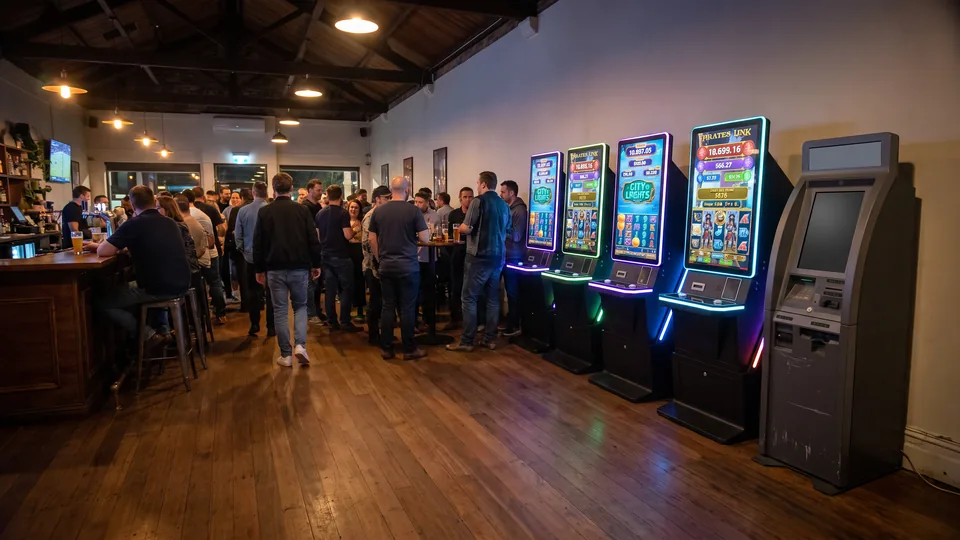
That last one is what Foxfire does, and the footprint is the reason it fits this conversation. One machine measures about 2 feet by 2 feet. Machines are delivered in pairs, so two sit side by side at about 4 feet by 2 feet. Add the redemption kiosk at about 2 feet by 2 feet and a standard install lands at roughly 6 feet by 2 feet. Twelve square feet. It runs off a standard 120V wall outlet. The full footprint breakdown, including clearance and traffic flow, is in how much floor space does entertainment equipment actually need.
The split of responsibilities is what changes the arithmetic on a corner like this.
| You provide | The operator provides |
|---|---|
| Roughly 12 square feet of floor | The machines and the redemption kiosk |
| A standard 120V outlet | Delivery and installation |
| Staff who know what is on the floor | Service, maintenance and repairs |
| Collections and reporting |
$0 setup. $0 maintenance. Your out of pocket cost to place is zero, which is the part that matters when you are deciding what to do with space that currently returns nothing. There is no capital to recover before the corner turns from a cost line into a revenue line. What it returns from there comes down to three things: how many people are in the building, how often they play, and how many machines are on the floor. The step by step version of the placement process is on how it works.
Be precise about the equipment, because in a room that serves families this is the first question anyone will ask. Foxfire builds a no-chance video game system. Every outcome is set in advance, and players can preview it before every play, so the element of chance is removed. Eclipse Compliance Testing, an independent accredited lab used by state gaming authorities and the lottery industry, reviewed the source code and found no random number generator. Its verdict, word for word: "This device is not a slot machine." Foxfire systems are certified at the source code level.
How do you judge an option before you say yes?
Hold every candidate against the same three questions, and the corner will usually pick for you.
- What does it cost me to find out? Count capital, inventory and labor. Zero out of pocket beats a promising idea that needs four thousand dollars up front and a month of your attention.
- Who fixes it when it breaks? Anything that sits unserviced becomes dead space that also occupies an outlet. Ask who comes, how fast they come, and what happens to the revenue while it is down.
- Does it hold anybody longer? Space that gives a guest a reason to stay for one more round earns twice, once on itself and once on the tab. That relationship is the whole argument in how to get customers to stay longer, and spend more while they do.
Then go measure. Take a tape to the corner, get the square footage, and run the three lines from the table above with your own rent and your own sales. If it turns out that twelve or twenty square feet of your dining room has never produced a dollar, you now know two things you did not know this morning: what that space is billing you, and what it should be worth. Restaurant owners can see how placement fits a dining room on the restaurants page.