Is anyone actually eating out between lunch and dinner?
Yes, though not for a meal. Circana's May 2026 foodservice outlook forecasts that afternoon snack traffic will edge up 2 percent over the next three years, and that beverage only visits will rise 2.3 percent by 2028. Nation's Restaurant News, citing Technomic in March 2026, reported that snacking occasions in restaurants are up by nearly 7 percent while overall traffic is down.
Read those two together and the window looks different. Total traffic is flat. The reason people leave the house at 3pm is not. Somebody wants a coffee and a chair. Somebody wants one drink before the drive home. Somebody wants an appetizer instead of dinner.
None of that is a rush, and no promotion will turn it into one. It is a thin stream of small tickets from people who picked a room to sit in. You are not competing for a dinner reservation at 3pm. You are competing to be the room.
Why does the afternoon cost you more than it looks?
Because the hour bills you the same whether anyone sits down or not. Rent, insurance and the lights were settled the day you signed the lease. The one line you can really move in the afternoon is labor, and you cannot move it to zero. Somebody has to prep the dinner book. Somebody has to be on the floor when the door opens.
Put a number on it. The Bureau of Labor Statistics puts the median hourly wage for food and beverage serving and related workers at $15.24 as of May 2025. Hold one person on the floor through a three hour afternoon gap and that is about $45.72 a day at the median, or about $320 across a seven day week. That is one person. It is before the cook, before the manager on salary, and before the first dollar of food cost.
You are already spending that money every afternoon. Waiting for the market to hand the hour back is not a plan either. The National Restaurant Association's 2026 State of the Restaurant Industry, published in February 2026, projects industry sales of $1.55 trillion this year on real sales growth of 1.3 percent. A rising tide of 1.3 percent is not going to fill your 3pm.
Does a happy hour actually make money in those hours?
It can, and the arithmetic decides it rather than the idea. Search this problem and the first page of results is a stack of happy hour guides. Not one of them prices the drink it is telling you to discount.
So price it. Say a cocktail sells for $8 and costs you $2 to pour. Both numbers are illustrative rather than measured, but the shape holds at any price. That drink carries $6 of gross profit. Cut it to $5 and the same drink carries $3. You now have to sell two of them to make what one used to make.
Two problems fall out of that. The first is volume. Doubling drink count is the hardest thing to do in the hours when the room is emptiest. The second is quieter and worse. The discount also lands on the people who were going to pay $8 anyway, so part of the price cut is a refund to traffic you already had.
A discount earns when it brings in somebody who was not coming. It loses when it just reprices the regulars who were. Before you print the sign, work out which one you are buying.
What separates a fix that works from one that just looks busy?
One question. Does it need a paid person standing there for it to work? That single test sorts the whole list of slow hour ideas, and it sorts it fast.
The afternoon's problem was never a shortage of ideas. It is that most ideas add cost in the exact hours you have the least revenue to cover them. Live music has a fee. Trivia has a host. A private booking needs staff on the clock. Every one of them can work, and every one of them starts the hour in a hole.
| Slow hour fix | Needs a paid person during the gap | What it adds to the hour |
|---|---|---|
| Discounted happy hour | Yes | Less gross profit per item, plus bar coverage |
| Live music or trivia | Yes, plus the performer or host fee | A cost paid before anyone walks in |
| Private bookings | Yes | Staffing, and it only fills the hours that sell |
| Marketing push | No during the hour | Spend now, traffic later, if it lands |
| Placed entertainment | No | Floor space and a wall outlet |
None of those rows is wrong. The question is what you can afford to keep running in the weakest part of your week. A fix that runs itself can sit in the gap every afternoon for a year. A fix that needs staffing gets tried for a month and quietly dropped, which is what usually happens to it.
What can you run in the gap without staffing it?
Anything that earns off the people who are already in your building. That is the honest scope of an unattended fix and it is wider than it sounds. Somebody is waiting on a table. Somebody is at the bar with one drink and twenty minutes. Somebody is killing time before a movie.
The other thing that runs itself is the space. A corner by the door or the end of the bar rail charges you rent every month whether or not it does anything. We put a dollar figure on that in what your dead floor space is actually costing you. In the afternoon that same corner picks up a second job. It is the piece of the room a waiting guest is standing in, which is also the moment a longer visit turns into a bigger check.
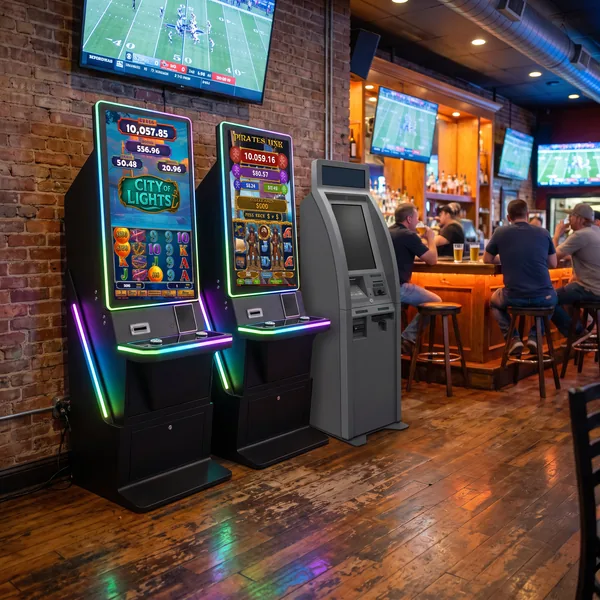
Placed entertainment fits that corner because of the footprint. One machine is about 2 ft by 2 ft. The full standard install, two machines plus a redemption kiosk, is about 6 ft by 2 ft, which is roughly twelve square feet, and it runs off a standard 120V wall outlet. That is a corner, not a renovation. How placement works in a restaurant covers the rest of the mechanics.
Where does a no-chance video game system fit?
It answers the one question with a no. Foxfire places a no-chance video game system in your venue. You provide the floor space and the outlet. The operator provides the machines, the delivery and the install, the service and maintenance, and the collections and reporting. Setup is $0 and maintenance is $0.
The words no-chance are doing real work in that sentence. Players preview their outcome, choose to play, and collect their prize. There is no random number generator anywhere in it. Eclipse Compliance Testing, an independent lab accredited to ISO/IEC 17025 and 17020 and used by state gaming authorities, reviewed the source code and wrote the verdict plainly. "This device is not a slot machine." The systems are certified legal in all 50 U.S. states. What that means for your specific room is a question for your own counsel. How it works lays out the paperwork that ships with an install.
For your afternoon the practical part is smaller than all of that. It sits in the corner. It is there for the guest waiting on a table at 3:40. Nobody has to be scheduled to run it.