Does passenger dwell time actually turn into concession spend?
It is 6:40pm at a gate two hours from boarding. The board already shows a delay. Three people stand near your counter with their phones out, not sure what to do with the next ninety minutes. That is not dead time. It is spend waiting to happen.
One industry report found that airport passengers spend about $7 for every hour they wait in a terminal. "Dwell time" just means how long a passenger sits or stands around before they board. The same report found the opposite is true of a security line. The longer someone waits in that line, the less they spend, not more. Waiting near your counter is worth something. Waiting in a screening line is not.
Monday morning: next time a flight shows a delay, look at how many people are standing where they can see your counter instead of walking past it. That is the $7-an-hour crowd, not the screening-line crowd.
Why does concession revenue per passenger move even when nothing at my counter changes?
Your airport likely tracks a number called concession revenue per passenger. It sounds simple. Take total spending across every store and restaurant, and divide it by how many passengers came through. But that passenger count often includes people who never had a chance to spend anything with you. It counts travelers who connect through a separate zone that never touches your concourse. It counts people who board from a remote stand by shuttle bus. It counts anyone flying so early or late that the shops nearby are still closed.
That matters because one flight's schedule can move this number a lot, even when your actual sales do not change at all. If your number drops one quarter, ask a simple question first. Did your own sales actually fall? Or did the passenger count behind the number just grow for reasons that had nothing to do with your counter?
Monday morning: ask your airport's commercial office how they count passengers for that number. Knowing what gets counted is the difference between chasing a real problem and chasing a reporting glitch.
What does your minimum annual guarantee or percentage rent actually bet on?
Most concession leases use one of two setups, or the higher of the two. A minimum annual guarantee, usually called a MAG, is a fixed rent you owe no matter how slow a quarter gets. Percentage rent is a straight share of your sales instead. One operator put the difference in plain words. A fixed guarantee feels bad because it never moves when your business does. A share of sales at least moves the same way your own ups and downs do.
Airports publish a yearly industry benchmark for what food and beverage concessions typically pay in rent, and DWU Consulting summarizes it. Hold your own lease against that benchmark, whether you are on a straight share of sales or a MAG that was set using it.
| What the airport gets | What you are betting on | |
|---|---|---|
| Minimum annual guarantee | A fixed rent, no matter what you sell | That your sales stay well above that floor |
| Percentage rent | A fixed share of whatever you sell | That your rent falls with a slow quarter too |
Monday morning: pull your own lease. Check which setup you are on, and how your rate compares to the industry benchmark for food and beverage.
What are other terminals already putting in the gate area?
Detroit Metro's McNamara Terminal did not guess at this question. As part of an $18.8 million concessions project, one that also added a dozen new shops and six new restaurants, the airport brought in two video game lounges built just for passengers with time to burn between flights. One lounge seats twelve players at once on current game consoles. The other adds a smaller retro gaming section next to it. The lounge operator's own co-founder said opening at that terminal was a spot they were "thrilled" to add.
Terminals in general are moving the same way. Trade coverage of airport dining says gate areas are shifting away from pure "get in and out fast" space. They are becoming more like a place to gather, built to hold both a traveler with ninety minutes to spare and one walking straight to the jet bridge.
Monday morning: you do not need a multi-million dollar buildout to test the same idea. You need one corner of the space you already lease.
Where does a Foxfire placement fit inside the lease you already have?
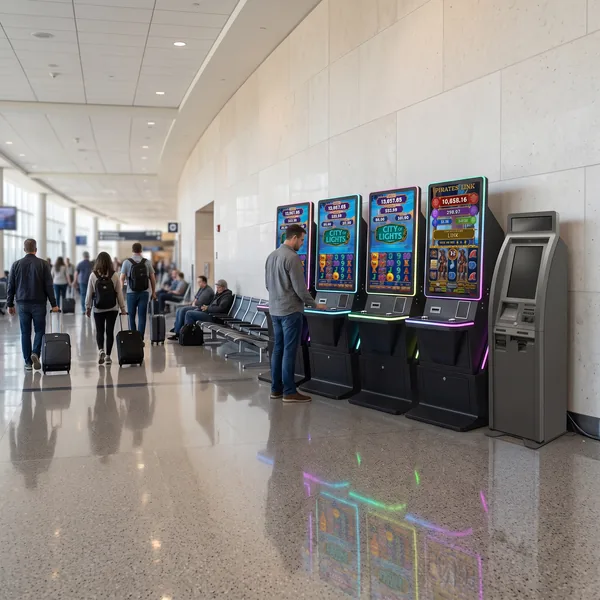
Foxfire places a machine at zero cost to you, the same way in a terminal as in any other venue. Foxfire brings the machines and the redemption kiosk, the delivery and the setup, the service, and the collections and reporting. You bring the floor space, a standard wall outlet, and staff who know what is on the floor. One machine is about 2 feet by 2 feet. A standard setup is two machines plus a kiosk, about 6 feet by 2 feet, roughly 12 square feet. That is small enough to sit along a wall near seating without touching table count or walking room.
Some readers picture a machine that pays out by chance the moment "machine in a terminal" comes up. Foxfire is not that. Each system is a no-chance video game. The outcome is set ahead of time and shown to the player before they pay, so chance is removed entirely. No RNG. No PRNG. No random process at all. Zero. Eclipse Compliance Testing, an independent lab used by state gaming authorities and the lottery industry, checked the source code and confirmed it. Their verdict, word for word: "This device is not a slot machine." Foxfire systems are certified legal in all 50 U.S. states.
Foxfire is not installed in any airport today, and nothing here claims otherwise. A placement inside a terminal still has to clear your own concession agreement and your airport's own approval process, the same as any other change to your leased space. Want the plain read on how a deal like this usually works, and what "no cost" really means? How revenue share machine placement works covers what you sign. Before you sign with any vendor, read what to ask before signing with any entertainment vendor first. If your space is tight, how much floor space entertainment equipment actually needs walks through the real numbers.